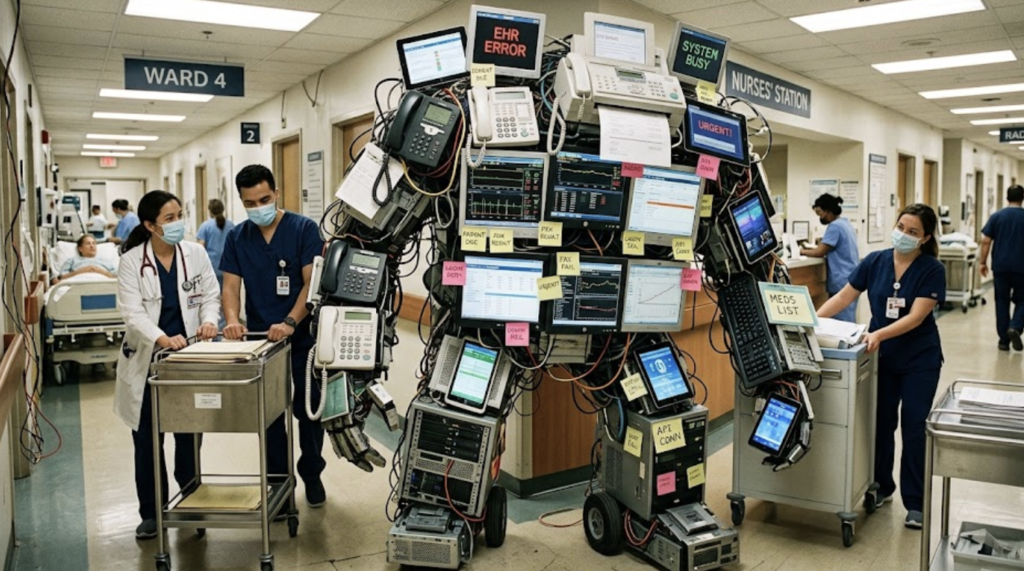
For the last thirty years, healthcare organizations have been building technology the same way many old cities built roads.One street was added because it solved a problem.
Then another.
Then a bridge.
Then a bypass.
Then a tunnel.
Over time, nobody was looking at the entire map. They were simply solving the problem directly in front of them.
Healthcare technology evolved much the same way.
An EHR was implemented. Then a patient portal. Then a scheduling platform. Then a CRM. Then a telehealth solution. Then a reputation management tool. Then a digital intake platform. Then a patient engagement platform. Then a call center solution. Then a chatbot. Then a revenue cycle platform.
Each decision made sense at the time.
Each solved a legitimate problem.
But very few organizations ever stopped to ask a larger question:
What happens when all of these systems have to work together?
The answer is what many healthcare organizations are experiencing today.
A Frankenstack.
A collection of technologies stitched together over years or decades, each with its own workflows, databases, interfaces, user experiences, and operational assumptions.
And now, as artificial intelligence enters the picture, the problem is becoming impossible to ignore.
The challenge is not that organizations lack technology.
The challenge is that they have too much of it.
Every week, a new AI vendor promises to solve scheduling. Another promises to automate patient communication. Another claims it can handle intake. Another offers clinical documentation. Another offers voice agents. Another offers care coordination.
The temptation is understandable. The opportunities are real.
But without a broader orchestration strategy, organizations risk creating an entirely new generation of fragmentation.
One AI agent texts the patient.
Another emails them.
A third calls them.
A fourth sends a portal message.
The patient receives four different communications from four different systems, none of which know what the others are doing.
Meanwhile, staff members are trying to understand which platform owns which workflow, where information is stored, and which alerts actually matter.
What began as an effort to improve efficiency can quickly become operational chaos.
This is why the conversation healthcare needs to have is not about which AI tool to buy.
It is about orchestration.
The future will not belong to organizations with the largest number of AI vendors.
It will belong to organizations that create intelligent coordination across their technology ecosystem.
In many cases, the answer is not ripping everything out and starting over.
That is rarely practical. Healthcare organizations have invested millions of dollars building the infrastructure they rely on today. Core systems such as EHRs, scheduling platforms, billing systems, and communication tools often remain critical to daily operations.
At the same time, simply layering new AI solutions on top of aging infrastructure without a strategy can create even greater complexity.
The reality is that modernization usually lives somewhere in the middle.
Some systems should be preserved.
Some should be optimized.
Some should be connected differently.
Some should be replaced entirely.
The challenge is determining which is which.
That requires a deep understanding of both healthcare operations and technology architecture.
It requires understanding not only what a system can do, but how people actually work within it.
Technology decisions made in isolation rarely succeed in healthcare. Workflow is where success or failure ultimately occurs.
The organizations that navigate this transition most successfully will be the ones that approach modernization intentionally. They will evaluate their current ecosystem honestly. They will identify areas of overlap, redundancy, and operational friction. They will create governance structures around AI adoption. And they will build toward a future state that is coordinated rather than fragmented.
At Agentic Healthcare, we believe every organization deserves an honest assessment of its current reality.
Not every problem requires a new vendor.
Not every legacy system needs to be replaced.
Not every shiny new AI solution belongs in your environment.
Our role is to help organizations understand what their current technology stack can and cannot do, identify the operational constraints that matter most, and develop a roadmap that aligns modernization efforts with clinical, operational, and financial goals.
Because the goal is not to create a larger Frankenstein.
The goal is to build a technology ecosystem that finally works together.
Healthcare does not need more disconnected applications.
It needs orchestration.
And in the age of AI, orchestration may become the most important competitive advantage of all.